

Picture Framing

What is the difference between standard framing glass and museum glass?
1. Ordinary glass is perfectly smooth, contains no inclusions, and produces no distortions, yet it does create glare. In addition, it readily shows fingerprints and quite clearly reflects the surroundings, especially when dark tones predominate in the image. When ordinary glass is used in frames for photographs, a problem of perception arises due to glare from lighting fixtures appearing on the glass.
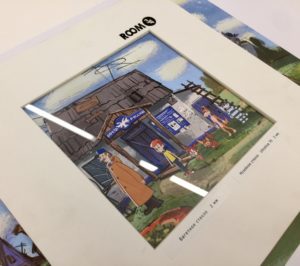
2. Museum glass does not glare thanks to a special treatment. This effect is achieved through magnetron sputtering of the surface, as a result of which it becomes rough and acquires unique optical properties: a ray of light striking the glass is not reflected but scattered. At the same time, light transmission increases significantly (it becomes matte). Such glass is often called “invisible,” as one wants to touch it with one’s hand to make sure whether it is there or not.
Putting it into figures, museum glass has light transmission of more than 98%, light reflection – less than 1%. Depending on the “layers” of magnetron sputtering, from 60 to 92% of ultraviolet light is blocked, thereby solving the crucial task of protecting the image from its destructive effects. It is impossible to block more without a loss of the glass’s optical characteristics.
3. The average price of museum glass is 20 times higher than that of ordinary glass.

4. Museum glass is the ideal means of framing graphics, watercolors, photographs, as well as for use as ultra-transparent displays for three-dimensional works, archival documents, and valuable collector’s items.
5. Laminated anti-vandal museum glass is capable of retaining shards within the frame upon impact, which allows one to speak of the highest degree of protection of the image from damage.
Maxim Krasnitsky
Creative visionary, friend and partner of the gallery and
owner of the framing workshop ROOM34