
“Another Planet”

Stories of Iceland by the artist Anastasia Zakharova

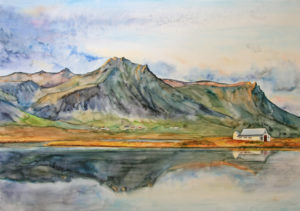
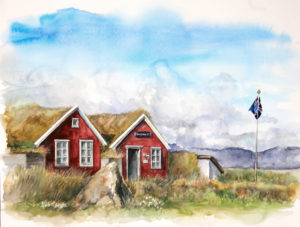
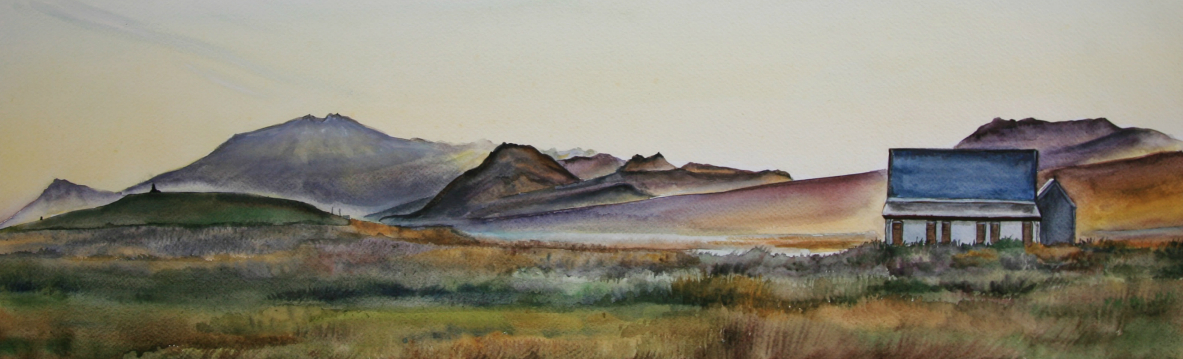
On January 15, Anastasia Zakharova's solo exhibition "Another Planet" opened at the Artplay Design Center.
The project grew out of impressions from a journey through wondrous Iceland in the summer of 2016. Through every artistic means at her disposal, the artist seeks to relive those days and share her emotions with us.

Icelandic Legends

Most of Iceland’s landmarks are bound up with legend. One of the most recognizable places in photographs is the black beach of Reynisdrangar near the town of Vik, with rocks jutting from the water, nicknamed the “Troll’s Fingers.” The legend tells that two trolls once tried to drag a three-masted ship ashore there, but turned to stone with the first rays of the sun.

Glaciers, too, are often credited with mystical properties. In one of them, according to popular belief, lies an entrance to the center of the Earth. The French science-fiction writer Jules Verne sent his heroes on their long and perilous journey into the Earth precisely by this path. Incidentally, Iceland is also said to hold an entrance to hell, hidden in the volcano Hekla, notorious for its furious and sudden eruptions.
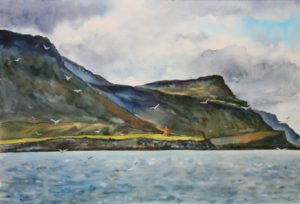
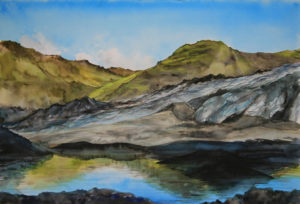
Whale Fjord

If you drive north from Reykjavik along national road N1, after 30 km you will arrive at the place where Whale Fjord begins. The slopes of low mountains descend to the water, forming picturesque shores. Driving along the fjord is a delight — the road is winding, full of steep climbs and descents, and almost always empty. 
Besides the museum and the remains of a whaling station, the fjord’s best-known landmark is the waterfall Glymur — the second highest in Iceland (196 m). The saga of Whale Fjord tells that once a fearsome shape-shifting whale with a red mark on its forehead struck a rock and brought this waterfall to life. Glymur means “rumble.” Water falling from a great height into a narrow canyon creates a deafening sound, thanks to the magnificent acoustics of the place.
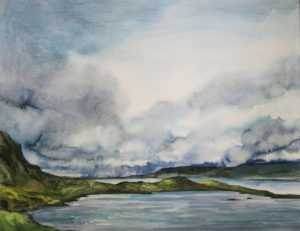
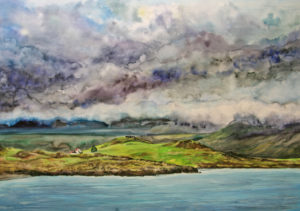
The Glacier Lagoon 
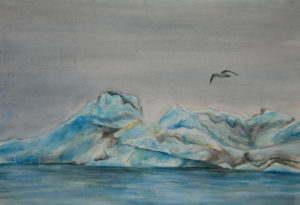
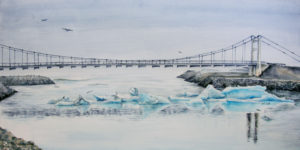
Jökulsárlón is the largest glacial lagoon and the lowest point on the island, lying 200 meters below sea level. In summer the icebergs melt and flow out to sea. In winter the lagoon freezes and is locked in ice. The icy water and soil create a unique ecological phenomenon. It is reported that over the past 15 years Jökulsárlón has doubled in size. Millennia-old blocks that have broken off from the glacier drift across the lagoon, sometimes cracking apart with a crash and raising quite large waves. Some of them reach 30 meters in height. 
Iceland has been and remains one of Hollywood’s favorite filming locations, thanks, of course, to its otherworldly landscape. More than one cinematic masterpiece has been shot at the iceberg lagoon. The legendary Agent 007 was spotted here twice: first during the filming of the 1985 movie “A View to a Kill,” in which Roger Moore played James Bond, and later for the 2002 film “Die Another Day” with Pierce Brosnan. Nearby, filming also took place for “Batman Begins” and the “Lara Croft” movies. 
But the most unforgettable and unexpected impression of the lagoon is the smell! Quite unexpectedly, the icebergs smell of watermelons.


On Lighthouses 

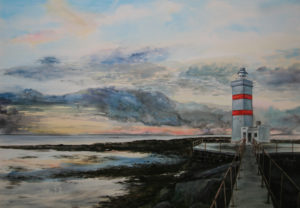
In Iceland, lighthouses hold a special place; the island even has an Icelandic Lighthouse Society that brings together companies and private individuals. The organization’s main aim is the preservation of lighthouses, their study, and the forging of links with contemporary culture. 
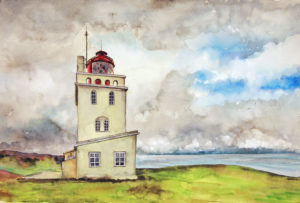
The first lighthouse was built in 1878 on Iceland’s southwestern coast, at Valahnúkur. The shoreline there was and remains very dangerous for ships. The lighthouse kindled a guiding light for sailors and made their passage safer. And at the beginning of the twentieth century five more lighthouses were built, completing a circle of 104 lighthouses around Iceland. 
If you drive out onto the Snæfellsnes peninsula, from afar you can see the tall Malarrif lighthouse. It is beautiful in itself, and nearby there is also a remarkable black beach and rocks of every shape. It is a working lighthouse, and both times we visited the place the weather was truly Icelandic — that is, with a fierce, gusting wind and spray that was either rain or the ocean. On such days the 30-meter lighthouse looks especially imposing against the elements!


The Land of Lupines 

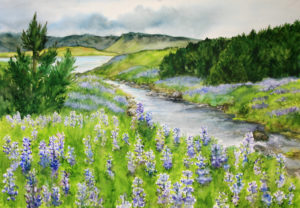
Preparing for Iceland, we studied a great deal about its nature, traditions, wildlife, and sights, yet nowhere did we come across the information that we would find ourselves, like Dorothy, in a violet country. It was a complete surprise! 

Arriving at Keflavik Airport at night under a full moon, we scarcely met night at all. It was more like soft twilight. But the enormous moon shone faithfully and, lighting our way along the island’s deserted roads, mystically tinted the landscape in pastel shades of violet — a continuous carpet of lupines covering everything! Remarkably, for all the variety of hues, the plants had unanimously chosen Iceland exclusively in violet. 

This magic lasted for about another month — violet fields, violet mountains, violet islands with a barely perceptible delicate fragrance. And to this day the impression left by that moonlit lupine landscape remains one of the brightest of our Icelandic journey. 


Snæfellsnes
 
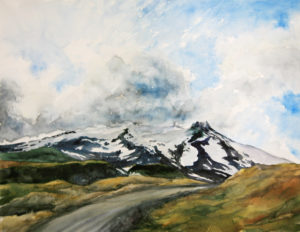
One of Iceland’s most fascinating places is the Snæfellsnes peninsula in the west of the country. Its name comes from the volcano Snæfellsjökull. The peninsula is said to be Iceland in miniature. And indeed, here you can find everything within a short distance of everything else: volcanoes and glaciers, lighthouses and caves, basalt columns and waterfalls, hot springs and waterfalls again, and lava fields… there is no end to the list. The Snæfellsjökull glacier is clearly visible from Reykjavik, though it rises only 1,446 meters above sea level. It was this glacier that inspired Jules Verne’s “Journey to the Center of the Earth.”
 
Snæfell means “snow mountain,” and Snæfellsnes — “peninsula of the snow mountain.” The glacier’s snowcap remains even in midsummer. On the peninsula you can descend into the lava cave Vatnshellir Cave, which is 8,000 years old. There are incredible beaches with black sand and, a rarity in Iceland, golden sand. And there is also Ytri Tunga beach, a favorite haunt of seals. And the most wonderful thing is that you can visit the Snæfellsnes peninsula again and again, each time astonished by its variety and by the remarkable transformations it undergoes depending on the weather.
 

Anastasia Zakharova,

artist, designer, traveler