
Friends of Our Gallery

Most of us know what interior design is!
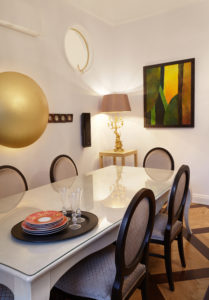
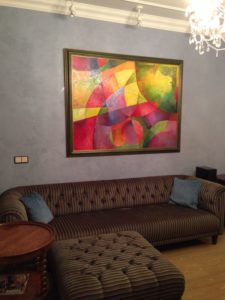
It is commonly believed that beautiful and carefully chosen finishing materials, furniture, lighting and textiles are enough to create the perfect interior. But we know that this is not always sufficient — interior décor is essential: accessories, works of art, expressive accents and especially paintings, for today it is painting that increasingly plays the leading role in an interior. A painting often takes an active place in filling and completing a space — it is a decorative accent capable of creating a vivid impression and bringing a room to life.
What is a painting? First and foremost, it is image and colour!
Abstract artists such as Mark Rothko or Wassily Kandinsky, for example, used colour to depict emotions and feelings that cannot always be expressed in words, realistic forms and lines. The combinations of these colours, forms and lines in their works still find resonance in our souls and hearts. Why? Because they convey energy, states of being and moods.
…“colour is valuable in itself; through harmonious colour combinations one can express every emotion and convey every spiritual value.”
Wassily Kandinsky compared colours precisely in their combination and interaction with one another.
“Violet is a cool red, both in the psychological and the physical sense. It carries the character of something ailing and extinguished and holds a note of sadness. A medium red evokes a sense of constancy and sharpness of feeling. It is like a passion burning steadily. It is an unquenchable, self-assured force that can be extinguished by blue, as hot iron is quenched by cold water.”
So the artist reasons.
The effect of abstract and non-representational art is as varied aesthetically as it is emotionally. In contemplating abstract painting and the colour within it, one may even achieve a therapeutic effect. Combinations of paints and textures can heal, soothe and invigorate, stir the imagination and develop fantasy.
Thus external colour either eliminates or weakens internal colour; colour is a stimulus. In the same way, the colours of the clothes we choose educate our souls. Scientists, for their part, have identified the physiological and psychological components of colour’s effect on a person (or the bodily and spiritual components). These two components are closely related to emotions — to the bodily manifestations of our soul.
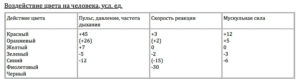
In working on any interior, it is necessary to apply the concept of art therapy, in which colour is of great importance and exerts an influence on the human body. Art therapy (from the English art, “art”) — a direction in psychotherapy and psychological correction based on art and creativity. In the narrow sense of the word, “art therapy” usually means therapy through visual art, aimed at affecting the patient’s psycho-emotional state.
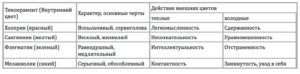 In my work when creating a painting, I try to learn as much as possible about the person, their interests, views and notions, in order to compose a psychological portrait. In conversation, I observe their behaviour, reactions and emotions. The interior itself also helps me in this. Then, taking into account the various symbolism of colour, I try to use its intonational and expressive qualities and create works that become not merely part of the interior, but part of the individuality of its owner.
artist, decorator
Works by Gallery Kvartira S artist Oksana Nazarova can be viewed here.