
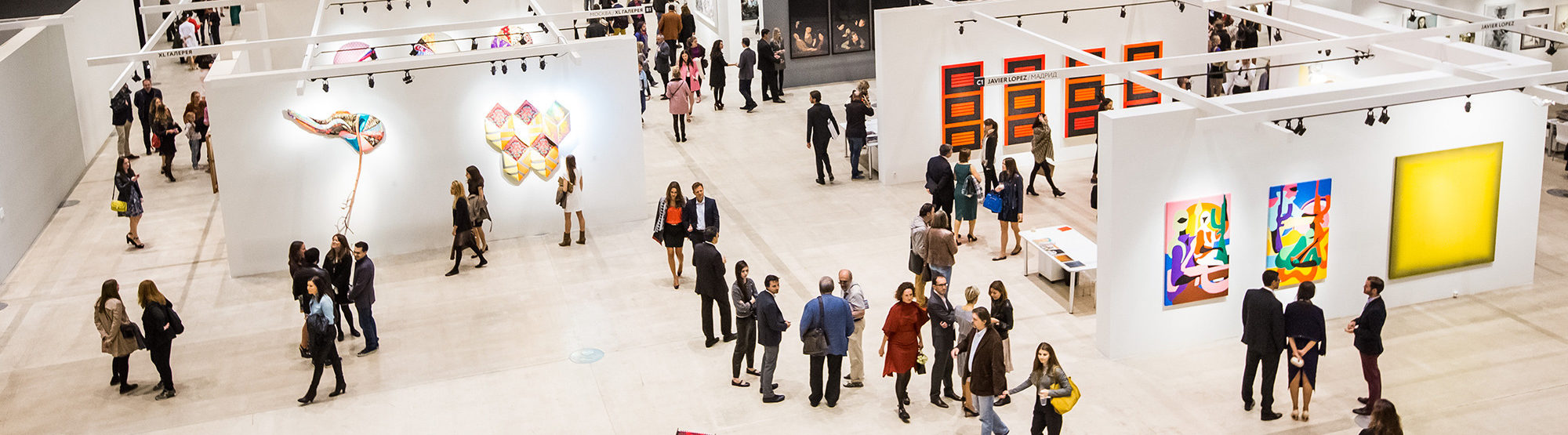
Cosmoscow 2017: We Were There, We Saw, We Share.
For Those Who Missed Russia’s Only Contemporary Art Fair
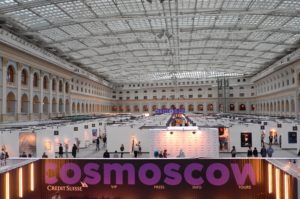
Quite recently, the Cosmoscow International Contemporary Art Fair took place at Gostiny Dvor in Moscow.
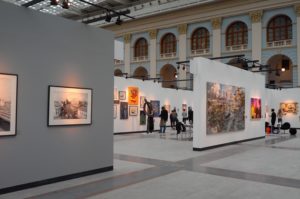
How it was organised. The fifth-anniversary edition brought together 54 galleries and more than 150 artists from Europe, America, the Middle East, and Russia. The exhibition was divided into five sections: Main — established Russian and European galleries with a long and successful presence on the art market; Collaborations — joint projects by Russian and European art dealers; Discovery — emerging galleries (although a couple of long-established names somehow found their way in as well, such as Roza Azora); Past Present — “classics of Russian contemporary art” (including Igor Makarevich, Sergei Volkov, Yuri Zlotnikov, and Valery Koshlyakov); and Focus — five hybrid galleries from Norway.
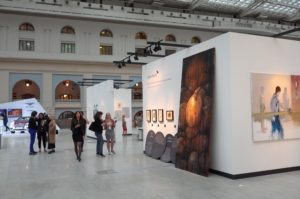
This year, the Cosmoscow organisers managed to attract a larger audience despite the City Day celebrations and traffic restrictions in the centre of Moscow. Over the course of three days, the fair welcomed 19,200 visitors. Media personalities dropped by (such as the autumn’s leading newsmaker, Andrei Malakhov) alongside guests well versed in art (Vladislav Flyarkovsky, presenter on the Russia-Kultura television channel, Zelfira Tregulova, director of the Tretyakov Gallery, and many others).
The event was decidedly more interesting and varied than last time. Still, Cosmoscow 2017 offered little in the way of outright provocation or mischief: everything remained within the bounds of a polished, restrained “presentation” of art for sale.
Alongside works by established Russian masters who have already stood the test of time, visitors could also encounter some “fresh” names. (But, as always, there were not enough of them).
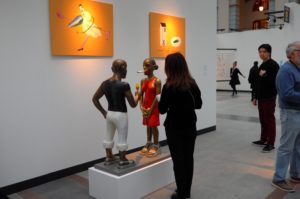
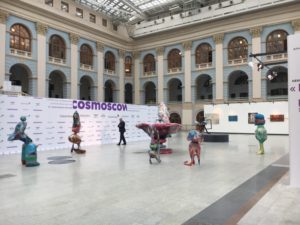
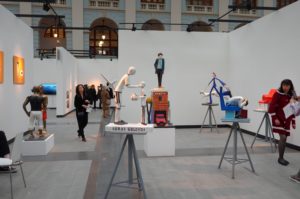
It is worth noting that this year the fair featured numerous large-scale, sculptural, and “multi-tiered” works: at the entrance stood a composition of metal, wood, and fabric by the young Voronezh artist Ivan Gorshkov (incidentally, the “Cosmoscow 2017 Artist of the Year”); deeper inside the hall was an Instagram sensation — a two-metre steel roly-poly toy (a nod to Jeff Koons and his worldwide success); while an enormous photograph by Sergei Bratkov, bearing the glowing and ambiguous sign “Uekhat zabyt,” drew the eye (and prompted reflection).
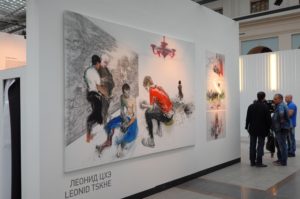
A few words about pricing: works by Anya Zhelud (a participant in the main project of the 2009 Venice Biennale) started at €500; works by Ilya Fedotov-Fedorov (a participant and “star” of the 7th Moscow International Biennale) ranged from €1,000 to €5,000; paintings by the already celebrated Pavel Pepperstein started at €52,000; sculptures by Alexander Povzner averaged €12,000; abstractions by Nikolai Koshelev ranged from €4,000 to €20,000; and paintings by Vladimir Dubossarsky cost around €20,000.
Most works were priced between €2,000 and €20,000 (the most expensive piece was Oleg Tselkov’s “Unitaz i agavy”).
The only drawback worth mentioning was that the foreign galleries invited to the fair offered relatively little of value or interest and served largely to uphold its status as an “international fair” (and to show us what contemporary art is like in their part of the world).
To be honest, though, accusing Cosmoscow 2017 of any serious failing would require something to compare it with. For now, there is nothing comparable in Russia. No other fairs remain on the Russian art market. And no one knows when any will appear.
The 2017 “cross-section” of contemporary art had been made. Some things were sold and some were bought, but Cosmoscow is primarily a meeting place for gallerists, artists, museum professionals, and, occasionally, collectors. One of the fair’s great strengths is its ability to answer the questions of non-specialists and ordinary curious visitors: what is contemporary art, why is it art, how much does it cost, and why does it cost so much?
We look forward to Cosmoscow 2018.

Olesya Sudzhan,
Director of Kvartira S Gallery