

Stories of Paintings by Renat Semenov
From the Artist
Gallery artist Renat Semenov, Member of the Union of Artists of Russia since 2000. He has taken part in nationwide and regional art exhibitions. His first solo exhibition was held in Beijing (1995); the most recent one, in Abakan (“Strange Dreams of Miguel D., 2017”). His paintings and graphic works are held in private collections in Russia, the United Kingdom, and Germany.

Renat tells the gallery "Kvartira S" about his works of art.
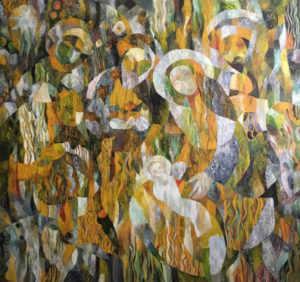
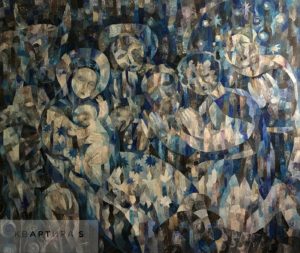
“Adoration of the Magi”, like “Adoration of the Shepherds”, is among the central subjects of Renaissance painting — today, sadly, almost vanished from the view of secular artists. “Adoration” is by no means an illustration; it is a confession of faith. The history of humankind is Christocentric, and its principal events should be spoken of through signs; therefore the main field of the diptych is fairly abstract, and only the central figures are free of distortion. The same holds true at the level of being: only what is sacred has weight; everything else is a scheme, an abstraction.
In childhood everyone was captivated by the illusion created by a kaleidoscope’s mirrors: turning it sets every part in motion, and so the picture is constantly changing. Our world, too, is a kaleidoscope, and as long as the earth turns, life will never tire of changing.
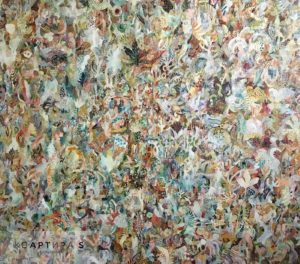
“The First Morning of the World” is the very beginning of the earth, the peak of its fullness, when decay had not yet touched its diamond facets. As all the colors of the spectrum fit into a drop of water pierced by light, so the earth itself, like a giant drop, accumulated within it the creative power of the Eternal. The painting’s title carries an allusion to the film “Tous les matins du monde” (dir. Alain Corneau).
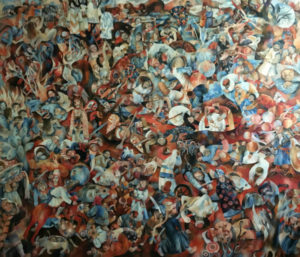
“Land of the Lazy” is as if Bruegel the Elder had lived in Russia. We are by no means a lazy country; it is simply that our notion of needs and comfort is somewhat different — or at least it once was. We can build a great country and walk about in a sack with slits for the arms. We could create masterpieces and live wherever we happened to be, a pebble under our head. That is why the “lazy ones” in the painting are rather active and endearing: they are our own people, carried by their own fancy into a land of milk and honey. Bread in Russia has never come free, so the dream of paradise on earth has always nourished us no less than bread itself.
The human world is fragile; sometimes it takes years to build a relationship, and a single word, one false phrase, can bring it down. We raise towers of Babel, then fear to come down again. We believe in strength, and there is never enough of it.
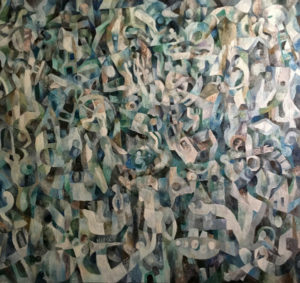
“Glass City” is like blue-green layers of glass, where people and reflections, fantasies and reality grow into one another. The painting is about how things really are: how much we deceive ourselves, pressed down by gravity and by our own experience. The world is not what it seems; it is more complex and more vulnerable, and for that reason needs our protection, as a beautiful Christmas ornament needs a layer of cotton wool, the warmth of a hand…
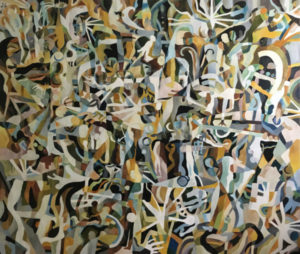
“Andalusia” carries an allusion to Spain, to the Moorish style. Yellow and black intertwine in it like a blinding sun and impenetrable night. Black is the color of a monastic habit; yellow — gold and lemon: somewhere at the junction of faith and passion a unique sound is born. It is a heart that is at once both sword and bell.
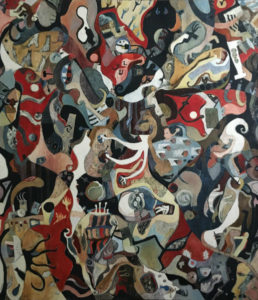
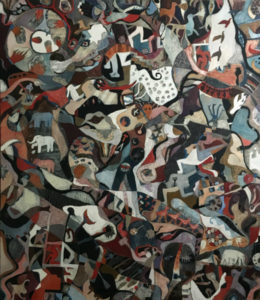
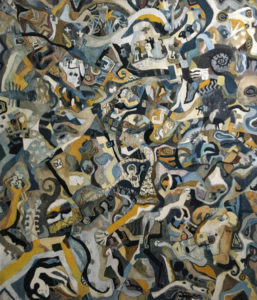
“Beyond the Edge of Sleep”, “Cross Rhythms,” “Silver of the Roads” are paintings that, oddly enough, were born under the influence of old Spanish painting and of illustrations by medieval illuminators, who combined Byzantine stylistics with the bright conventionality of Eastern miniature. The paintings unite both traditions; they are abstract and narrative at once — like dreams, like the fragmentary clarity of a glance caught in the window of a rushing train.
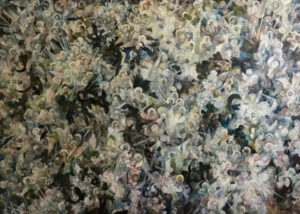
“Heavenly Battle” has a biblical foundation: it shows the struggle of angels and dark forces before the latter’s fall. One of the most widespread subjects of the Middle Ages is now rarely found on the canvases of contemporary artists, who cannot withstand comparison with the epics of the past. In “Heavenly Battle” evil is blurred and has no concrete features; the angels merge into a quivering cloud of light, yet we can still make out details: weapons, the decoration of plumage. There is no point competing with the ingenuity of Bruegel, the gigantism of Michelangelo, of William Blake. Nevertheless, the artist created his work with an eye to them — understanding that the grandeur of the conception can give abstract form the volume of a clear and powerful statement.